Water damage restoration is the process of removing water from a home, drying the structure to a measured standard, and repairing what the water ruined. Most US homeowners pay $1,361 to $6,282 for it, according to Angi's 2025 data. The single biggest factor in the final bill is speed: the EPA advises drying wet materials within 24 to 48 hours to prevent mold.
Water damage is the second most common home insurance claim in the country. Insurance Information Institute data for 2019 to 2023 shows about 1 in 67 insured homes files a water damage or freezing claim each year, and the average claim was $15,400. Most of those losses start small: a supply line, a water heater, a toilet, a pipe in an outside wall.
This page is the map. It covers what to do first, how restoration actually works, what drives the price, and how to choose a company. Each section links to a deeper guide.
What to do in the first hour
Before you think about cost or insurance, stop the damage from growing.
- Shut off the water. Close the main shut-off valve, usually where the water line enters the house, often in the basement, a utility closet or near the water heater.
- Make the area safe. If water is near outlets or appliances, switch off those circuits at the breaker panel, but only if you can reach the panel without standing in water.
- Photograph everything. Wide shots of each room, then close-ups of damage, before you move anything.
- Move what you can. Lift rugs, furniture and electronics off wet floors. Put foil or wood blocks under furniture legs that have to stay.
- Call your insurer and a restoration company. Many restoration companies work with insurers directly and can start extraction the same day.
If the water came from a sewer line or outside floodwater, keep everyone out of the area. The EPA says to call a professional for damage caused by sewage or other contaminated water. See our sewage backup guide for why.
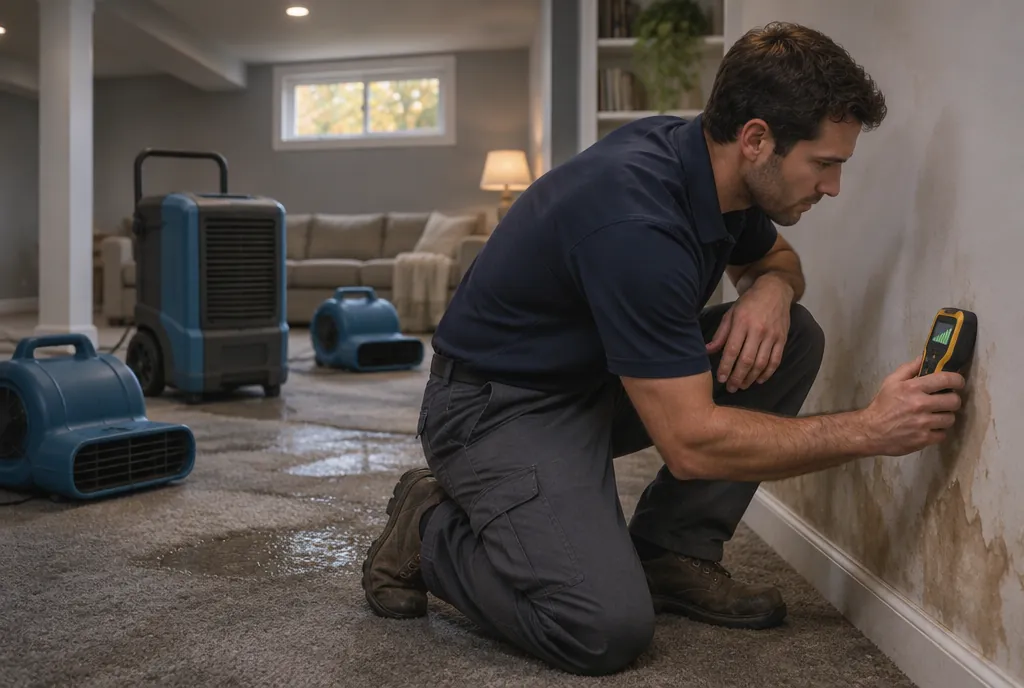
How professional water damage restoration works
Restoration crews follow the ANSI/IICRC S500 standard, the industry's rulebook for water damage. In plain terms, a job moves through five stages:
| Stage | What happens | Typical timing |
|---|---|---|
| Inspection | Find the source, classify the water (Category 1–3) and how far it spread (Class 1–4), map moisture | First visit |
| Extraction | Pump out standing water, pull water from carpet and pad | Day 1 |
| Demolition | Remove wet drywall, baseboards, insulation and pad that can't be dried | Days 1–2 |
| Drying | Air movers and dehumidifiers, with daily moisture readings | Usually 3–5 days |
| Repair | New drywall, paint, flooring and trim | After the structure tests dry |
The stage people skip is the one that matters most: measured drying. A wall can feel dry to the touch while the inside of the cavity is still wet. Good crews write down readings every day until materials reach their dry standard. Our restoration process guide walks through each stage in detail, and water mitigation explained covers the emergency half of the job.
The three things that decide the cost
How dirty the water is. Clean water from a supply line (Category 1) is the cheapest to deal with. Gray water from a washer or dishwasher (Category 2) costs more. Black water from sewage or outside flooding (Category 3) costs the most, because porous materials it touches usually have to go. Angi's per-square-foot figures run about $3.50, $5.25 and $7.50 for the three categories.
How far it spread. Water that stayed on a tile floor is a small job. Water that wicked up drywall, soaked insulation and got under hardwood is a large one.
How long it sat. Clean water left for days can grow bacteria and mold, which turns a simple dry-out into a contaminated-water job plus mold remediation.
Full numbers are in our water damage restoration cost guide.
Damage by room and material
Each material behaves differently once it's wet, and each has its own repair-or-replace decision:
- Ceilings: stains, sagging and collapse risk. See ceiling water damage and bathroom leaks through the ceiling below.
- Walls: wet drywall, baseboards and hidden leaks. See water-damaged drywall and water leaks inside a wall.
- Floors: hardwood, carpet and the subfloor underneath.
- Basements: flooded basements, often the most expensive single room to restore.
Common causes, and what each one usually means
| Cause | Typical water category | Usually covered by homeowners insurance? |
|---|---|---|
| Burst or frozen pipe | 1 (clean) | Usually, if sudden |
| Water heater, fridge line, dishwasher | 1–2 | Usually, if sudden |
| Toilet overflow (no waste) | 2 (gray) | Usually, if sudden |
| Sewer backup | 3 (black) | Only with a backup endorsement |
| Outside flooding | 3 (black) | No: needs flood insurance |
| Slow leak over weeks | Varies | Usually not |
Insurance rules vary by policy and state. Our homeowners insurance and water damage guide explains the "sudden and accidental" test insurers use.
How to choose a water damage repair company
You'll rarely have time to compare five companies when water is coming through a ceiling. These five checks take about ten minutes on the phone:
- Certification. Ask whether the technicians on your job hold IICRC Water Damage Restoration Technician (WRT) certification.
- Response time. A real 24/7 company can usually give you an arrival window in hours, not days.
- Moisture documentation. Ask if they'll give you daily moisture readings. If they hesitate, keep looking.
- Insurance experience. Ask whether they bill insurers directly and use estimating software adjusters recognize.
- Scope in writing. Get mitigation and rebuild priced separately, with equipment counts and expected days.
Watch for this: a company that asks you to sign an assignment of benefits before you've read it, or pressures you to start rebuild work before the structure is documented as dry. Read every authorization form, and keep copies.
Frequently asked questions
How long does water damage restoration take?
Extraction and drying usually take three to five days for a typical residential job, longer for large losses or dense materials like hardwood and plaster. Rebuild work comes after and can take one to several weeks depending on materials.
Can I dry water damage myself?
Small clean-water spills caught quickly, on non-porous surfaces, often can be. Once water has soaked drywall, insulation, carpet pad or subfloor, household fans rarely dry the inside of those materials fast enough to prevent mold.
Is water damage restoration covered by insurance?
Often, when the water came from a sudden, accidental event inside the home, such as a burst pipe. Gradual leaks and outside flooding are usually excluded from a standard homeowners policy.
What's the difference between water damage restoration and water mitigation?
Mitigation is the emergency work that stops damage spreading: extraction, drying equipment and removing wet materials. Restoration usually means the full job, including repairs afterwards.
Water damage restoration is fastest and cheapest when it starts in the first hours. Call the number on this page any time to reach a participating local restoration company.