Water damage restoration costs most US homeowners $1,361 to $6,282, with an average of about $3,822, according to Angi's 2025 cost data. Clean water from a supply line runs about $3.50 per square foot to dry out; contaminated "black" water runs about $7.50. Big losses that reach Class 4 can climb to $20,000 or more.
Water damage restoration cost is hard to pin down until someone with a moisture meter walks the job. A burst washing-machine hose caught in an hour is a different bill from a slow leak that soaked a subfloor for a week. So instead of one number, this guide gives you the ranges that matter, what pushes a job from the low end to the high end, and how to check a quote before you sign it.
We compared six national cost guides published between 2024 and 2026 so you can see how much they agree, and where they don't.
Water damage restoration cost at a glance
Six sources. One story. Most jobs land between roughly $1,300 and $6,300, and the averages cluster around $3,250 to $3,860.
| Source | Typical range | Average | What it covers |
|---|---|---|---|
| Angi (2025 data) | $1,361 – $6,282 | $3,822 | Extraction, drying and repair |
| HomeAdvisor (2025) | $1,364 – $6,301 | — | Full project; extremes $450 – $16,000 |
| PuroClean | $1,383 – $6,370 | $3,860 | Mitigation and restoration only, no rebuild |
| Bob Vila | $1,305 – $5,707 | $3,455 | Based on Angi and HomeAdvisor data |
| LawnStarter (2026) | $1,270 – $5,376 | $3,250 | Extremes $430 – $20,400 |
| Fixr | $3.75 – $7.50 per sq ft | — | Extraction priced by water category |
Notice the PuroClean line. Its numbers cover mitigation and restoration, not reconstruction such as painting, new drywall or flooring. That split matters more than any single average, and it's the first thing to check on your own quote.
Why one bill can be $1,300 and another $13,000
Three things decide most of your water damage repair cost: how dirty the water is, how far it spread, and how long it sat.
1. The water category
Restoration crews follow the IICRC S500 standard, which sorts water into three categories. Dirtier water means more protective gear, more antimicrobial treatment and more material that has to be thrown away instead of dried.
| Water category | Typical source | Angi, per sq ft | Fixr, per sq ft |
|---|---|---|---|
| Category 1 — clean | Supply line, faucet, rain | $3.50 | $3.75 – $4.25 |
| Category 2 — gray | Washer, dishwasher, toilet overflow (no waste) | $5.25 | $4.10 – $6.50 |
| Category 3 — black | Sewage, outside floodwater | $7.50 | $7.00 – $7.50 |
2. How far it spread (the "class")
The class describes how much moisture got into the structure. Fixr puts a Class 3 job, where water soaked walls and ceilings, at roughly $1,000 to $3,000 of drying work. Class 4 means water got into dense materials like hardwood, plaster or concrete, and Fixr's estimate jumps to $20,000 to $100,000 for those losses.
3. Time
Here's the thing most people don't hear until it's too late: clean water doesn't stay clean. The EPA advises that water-damaged areas and items be dried within 24 to 48 hours to prevent mold growth. Miss that window and a Category 1 job can turn into a Category 2 or 3 job, plus mold remediation.
What each part of the job costs
A restoration invoice is usually two invoices stacked together. Mitigation stops the damage. Restoration puts the house back.
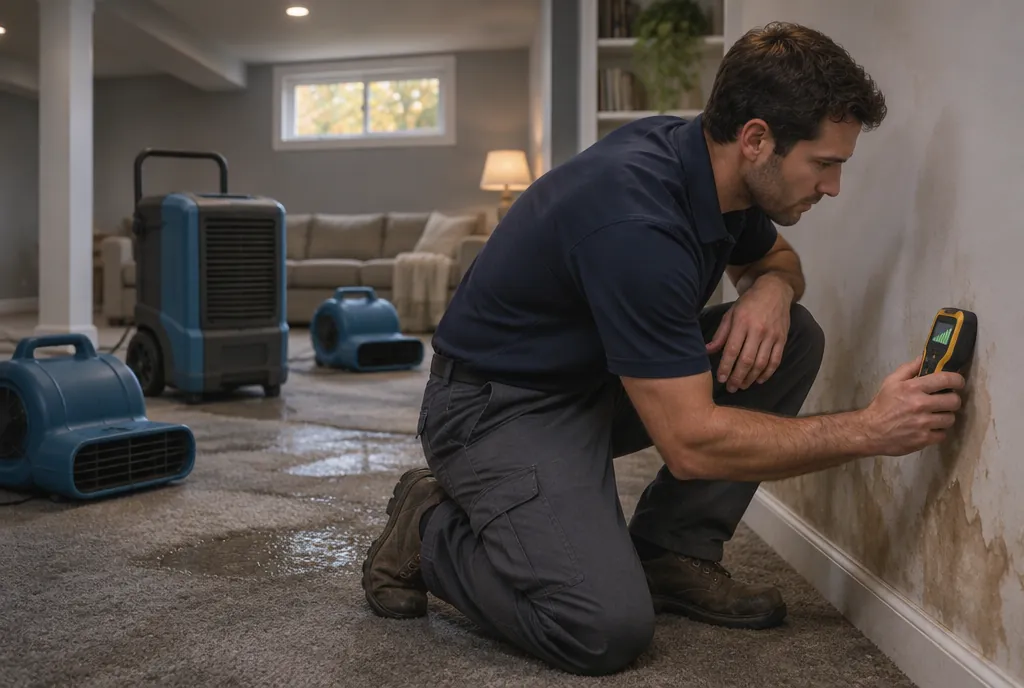
Water mitigation cost is the part people underestimate. It's the emergency work: extraction, drying gear and demolition. It's also the part insurers want documented first, because it limits how big the claim gets.
Material matters on the rebuild side. Fixr lists drywall at about $1.50 to $3 per square foot to restore, carpeting at $4.75 to $10.50, and plaster at $6.25 to $18.75. That last figure is why older homes with plaster walls often see higher totals for the same amount of water.
Water damage floor repair cost
Floors are where small leaks get expensive. Carpet over pad can often be dried in place if the water was clean and the crew got there fast. Hardwood is less forgiving: cupping and crowning can mean sanding, partial replacement, or pulling the whole floor if water reached the subfloor. Laminate usually has to be replaced once it swells. Ask the crew to check subfloor moisture before they quote flooring work, because a dry-looking floor over a wet subfloor is how mold starts weeks later.
Ask for the moisture map. A good crew takes readings at the start and every day after, and writes them down. Those readings are your proof that drying was needed, and they're the first thing an adjuster asks for if a claim gets questioned.
Where you live changes the price
Labor rates move the total more than most people expect. Angi's city data shows an average of $3,820 in St. Cloud, Minnesota and $4,450 in Detroit. Bob Vila's figures put Los Angeles at about $2,750 and Portland, Oregon at about $3,100. Expect to pay more in large metro areas, after regional storms when crews are booked out, and on nights and weekends.
Does homeowners insurance cover it?
Often, yes, if the water came from something sudden and accidental inside the house: a burst pipe, a failed water heater, a split supply line. Damage from a slow leak that went on for weeks usually isn't covered, because insurers treat it as a maintenance problem. Flooding from outside isn't covered by a standard homeowners policy at all; that needs separate flood insurance.
Flood losses also run on a different scale. In our analysis of FEMA's OpenFEMA data, the median paid National Flood Insurance Program claim since 2016 was $59,994 in Florida and $70,000 in Texas. See the full flood claims by state table.
Before you throw anything out: photograph every wet room, keep samples of damaged flooring and drywall, and call your insurer before major demolition if you can do it safely. Your policy may require it.
How to check a quote in 5 steps
- Ask for the water category and class in writing. It tells you which price per square foot should apply.
- Get mitigation and rebuild priced separately. You're comparing apples to apples only if both quotes split the job the same way.
- Check the equipment count and days. Five air movers for four days is a line item you can sanity-check against the room size.
- Ask who handles the insurance paperwork. Many restoration companies bill your insurer directly; some ask you to pay and claim it back.
- Confirm the crew is certified. Ask whether the technicians hold IICRC water damage restoration (WRT) certification.
Let's be direct about one thing: the cheapest quote often leaves the wall cavities wet. A job that skips demolition and monitoring looks fine for a month and then starts to smell.
Common mistakes that raise the bill
- Waiting to see if it dries on its own. Past 48 hours, mold becomes a real risk and the job gets bigger.
- Running household fans only. They move surface air but don't pull moisture out of drywall and subfloors.
- Repainting before it's dry. Stains come back, and trapped moisture keeps feeding mold behind the paint.
- Ignoring the ceiling below. Upstairs bathroom leaks often show up as a stain one floor down, days later.
Frequently asked questions
How much does water damage restoration cost per square foot?
Most published guides put it between about $3.50 and $7.50 per square foot, depending on how contaminated the water is. Angi lists $3.50 for clean water, $5.25 for gray water and $7.50 for black water.
What is the difference between water mitigation and water damage restoration?
Mitigation is the emergency work that stops damage from spreading: extraction, drying equipment and removing wet materials. Restoration is the repair afterwards, like new drywall, paint and flooring. They're often billed separately.
How fast should water damage be dried out?
The EPA recommends drying water-damaged areas and items within 24 to 48 hours to prevent mold growth. After that, the job usually gets bigger and more expensive.
Does homeowners insurance pay for water damage restoration?
Usually, when the damage comes from a sudden, accidental event inside the home, such as a burst pipe. Gradual leaks and outside flooding are usually not covered by a standard policy.
Why are some water damage quotes so much higher than others?
Quotes differ on water category, how much demolition is included, how many days of drying equipment are planned, and whether rebuild work is included. Compare quotes that split mitigation and rebuild the same way.
Water damage restoration cost comes down to the water type, the area and how fast drying starts. Call the number on this page and we'll connect you with a participating local restoration company for a quote.
Written and fact-checked by DryLevel editors, last updated 2026-11-16. Costs come from the sources linked in the article. Read our editorial policy or report a correction.